

A Pattern That Repeats Itself
Over the past decade, I've worked across 700+ AI transformations and facilitated over $2.1B in deals. And the pattern I've seen more than any other is this: the best AI product in a category is rarely the one people know about.
Not because it failed technically. Not because the team lacked talent. Not because the market wasn't ready. But because the people who should have heard about it never did.
The product worked. The distribution didn't.
This isn't a new problem, but in AI it's become acute. The number of AI tools in the market has exploded. Every company has a product page, a blog, a LinkedIn company page, and maybe a few case studies. And almost none of it is reaching the founders, operators, and business leaders who actually make adoption decisions.
The gap between having a great product and having people know about it has never been wider. This is the distribution gap. And it's the single biggest reason great AI products stay invisible.
The Numbers Behind the Gap
Let's start with the demand side. The appetite for AI tools is real and growing.
94% of organizations report increased appetite for AI investment over the past year, according to the Logicalis 2026 CIO Report surveying 1,000 CIOs globally. 80% of CIOs plan to increase AI investment in 2026 (Gartner 2026 CIO Survey). 85% of B2B marketers now use influencer programs, up from 34% in 2020 (TopRank Marketing). The global influencer marketing market has reached $39.33 billion.
There is no shortage of demand. There is no shortage of budget. The people responsible for evaluating and adopting AI tools are actively looking.
Now look at the supply side. Nearly 800 million people per week use ChatGPT alone to answer questions and compare options (WordStream, 2026). AI-powered search features have reduced organic website traffic by 15-64% across categories. Only 11% of B2B companies have the majority of their content ready for AI discovery (10Fold/Sapio Research, 2025). 51% of companies plan to increase investment in Answer Engine Optimization while only 14% plan to increase traditional SEO investment (Digital Bloom GTM Report, 2025).
The way people find AI tools has fundamentally changed. And most AI companies haven't caught up.
Five Reasons Great AI Products Stay Invisible
1. They're marketing to themselves, not to their audience
The most common mistake AI companies make is talking about their product the way their engineering team sees it. Feature lists. Technical specifications. Architecture diagrams. Integration capabilities.
None of this is wrong. All of it is irrelevant to most of the people who need to hear about you.
A founder doesn't care about your architecture. They care that it saved someone like them 10 hours a week. A manager evaluating tools doesn't need your API documentation. They need to know what happened when a company their size deployed it. A business leader doesn't read feature lists. They read about outcomes and peer benchmarks.
Research from Corporate Visions found that problem-focused sellers are 30% more effective than solution-focused sellers, yet only 13% of sellers take a problem-first approach. The same principle applies to content. Most AI companies lead with their solution. The audience is looking for their problem.
When your content talks about your product the way you see it rather than the way your audience experiences the problem it solves, you're creating content that satisfies your marketing team but reaches nobody who matters.
2. They're relying on channels that no longer work the way they used to
Five years ago, a B2B company could write good blog posts, optimize for Google, run some LinkedIn ads, and build a pipeline. That playbook is fracturing.
AI-powered search is replacing traditional search for B2B research. 72% of technology buyers now encounter Google's AI Overviews during their research process (AMPLYFI, 2025). 90% of those buyers click through to the sources cited in AI Overviews, not to the traditional search results below. AI referral traffic is significantly higher intent, with 58% of marketers reporting it converts better than traditional search traffic (KLIQ Interactive, 2025).
Meanwhile, organic reach on company LinkedIn pages has been declining for years. B2B buyers spend only 17% of their total buying time meeting with potential suppliers (Gartner). 33% of all B2B buyers prefer a seller-free experience, with that number jumping to 44% among millennial buyers.
The channels haven't disappeared. But the way they work has changed. Traditional SEO, company page posts, and vendor-driven content are delivering diminishing returns. The attention has moved to trusted voices, AI-generated answers, and peer recommendations. Companies still optimizing for the 2022 playbook are building on a foundation that's eroding underneath them.
3. They're invisible to AI answer engines
This is the gap that will define the next 3-5 years of AI company marketing.
When a founder asks ChatGPT "what are the best AI tools for customer support for a small team?" your product is either in the answer or it isn't. If it isn't, you don't exist in that person's consideration set. They'll never visit your website. They'll never see your demo. They'll evaluate the tools that the AI recommended and choose from those.
Only 11% of B2B companies have the majority of their content ready for AI discovery. That means 89% of B2B companies are essentially invisible to the fastest-growing research channel their audience uses.
The shift from "rank on Google" to "get cited by ChatGPT, Perplexity, and Google AI" is happening faster than most companies realize. And the companies that build content specifically designed to be cited by AI engines, structured with clear claims, specific data, named sources, and schema markup, will compound that advantage over the companies that don't.
4. They're relying on their own voice instead of trusted voices
Here's a number that should reframe how every AI company thinks about marketing: 87% of B2B buyers give more credence to content featuring industry experts they trust than to vendor-produced content (Demand Gen Report, 2025).
Your company blog, your product page, your LinkedIn company page: these are all your voice. And your audience has learned to discount them. Not because they're dishonest. But because every vendor says their product is the best. Every company claims to be "enterprise-ready." Every product page reads like every other product page.
The credibility gap between what companies say about themselves and what trusted third parties say about them has never been wider. In 2026, where AI-generated content is flooding every channel, the premium on authentic, expert voices is only increasing.
LinkedIn's 2025 B2B Marketing Benchmark found that 94% of marketers agree trust is the key to success in B2B. And 42% of senior B2B marketers say their top priority is increasing brand awareness and reputation among decision-makers.
But trust doesn't come from your own channel. It comes from voices your audience already follows. A carousel from someone a team lead respects carries more weight than a sponsored ad from your company page. A mention in a newsletter a VP reads every morning is worth more than a blog post on your website that nobody visits. A podcast conversation where a peer shares their real experience with your product builds more credibility than any case study you write about yourself.
5. They're reaching one level when the decision involves five
As we covered in our previous piece on how different levels discover AI tools, purchasing decisions in B2B involve multiple people across multiple levels. A team lead discovers. A manager evaluates. A director builds the case. A VP approves. A CXO validates.
Most AI companies create content for one level. Usually operators (feature-focused, tactical content) or CXOs (enterprise whitepapers, analyst-style content). Almost nobody creates content for managers and directors, who are arguably the most important audience because they're the ones who build the business case that either moves forward or stalls.
When your distribution only reaches one level, you're dependent on that person internally championing your product upward through the organization. That's a fragile strategy. If they don't have the language to present the business case, the momentum dies. If their manager never heard of your product, the recommendation gets questioned. If the VP has never seen your name anywhere, the proposal sits in a pile.
The companies that show up at multiple levels simultaneously create something different. They create the sense of "I keep seeing this company everywhere" that transforms a cold recommendation into a warm one. When a manager recommends your tool and the VP says "I've seen that name in a few places," the deal moves forward. When the VP has never heard of you, it stalls.
What Closing the Distribution Gap Actually Looks Like
The distribution gap isn't a problem you solve by creating more content. 91% of B2B marketers already use content marketing (DemandSage, 2025). The world doesn't need more content. It needs better distribution of existing signals.
Closing the gap requires three structural shifts:
Shift 1: From your voice to trusted voices.
The companies closing the distribution gap are the ones showing up through people their audience already follows. Creator-led distribution is growing at 18% year over year in the U.S. (IAB, 2026) because it works. It delivers trust that company channels cannot.
This doesn't mean abandoning your own channels. It means recognizing that your company blog is a repository and your LinkedIn company page is a storefront, but neither is a distribution channel. Distribution happens through the feeds and inboxes your audience already reads, via the voices they already trust.
Shift 2: From one channel to coordinated multi-channel.
Showing up once in one feed is easy to scroll past. Showing up from multiple trusted voices across LinkedIn, newsletters, and podcasts within the same week creates signal density. The audience moves from "I saw that once" to "I keep seeing this."
The B2B GTM research is clear on this. Always-on influencer engagement is rated effective by 99% of B2B marketers who use it. Campaign-based, one-off approaches are 17 times more likely to be rated as ineffective (TopRank Marketing, 2025). The data points to sustained, multi-channel, multi-voice distribution, not one-off content.
Shift 3: From one level to the full spectrum.
Reaching founders and operators is necessary but not sufficient. Reaching VPs and CXOs without reaching the team leads who drive adoption is equally incomplete. The companies closing the distribution gap are the ones who reach across the full spectrum of people involved in AI adoption: founders, operators, managers, directors, and business leaders.
This is hard to do alone. It requires different content formats, different messaging, different voices, and different channels for each level. It's the reason creator networks are emerging as the distribution infrastructure for AI companies, because a managed network with voices at every level can reach the full spectrum in one coordinated campaign.
The Distribution Gap Is the Opportunity
Here's the optimistic framing: because most AI companies haven't figured this out yet, the distribution gap is also the competitive advantage for the companies that do.
If you're an AI company with a strong product and weak distribution, you don't need a better product. You need better distribution. And in 2026, that means:
Getting your product talked about by trusted voices, not just your own team. Building content that AI engines can cite when people ask questions about your category. Reaching founders, operators, and business leaders simultaneously, not just one level. Showing up consistently through always-on distribution, not one-off campaigns.
The companies that close the distribution gap first will own mindshare at every level. They'll be the names that come up when ChatGPT answers a question about their category. They'll be the brands that VPs have "seen everywhere." They'll be the products that team leads recommend with confidence because their manager already knows the name.
The rest will keep building great products that nobody talks about.

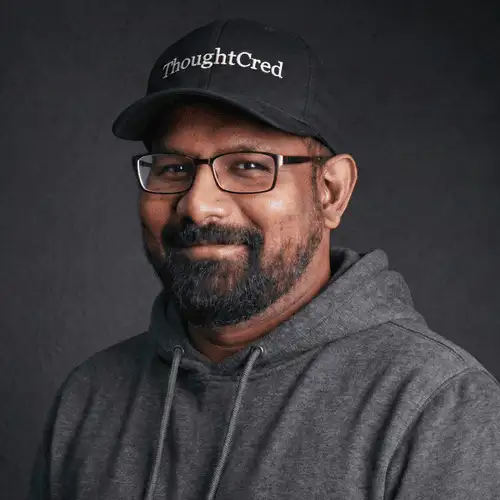
Joseph Abraham (Joe) is the founder of ThoughtCred and the Global AI Forum. A former CXO turned trusted advisor to CXOs, he helps enterprises evaluate and adopt AI with clarity and confidence. He champions Narrative Intelligence and enterprise-grade content, and is the architect of VEO (Vendor Evaluation Optimization), focused on how enterprises validate vendors and content, not just discover them.

.webp)

.svg)


