
.webp)
The Shift Nobody's Talking About
Something fundamental has changed in how AI and SaaS companies reach the people who matter.
For the past three years, the playbook was simple: find a creator with a relevant audience, negotiate a one-off deal, get a sponsored post, move on to the next creator. Repeat across 5-10 people. Hope for the best.
That playbook is breaking.
Not because creator-led distribution doesn't work. It works better than almost any other B2B channel right now. But the way most companies execute it, one deal at a time, one creator at a time, one post at a time, is fundamentally inefficient. And a new model is emerging that changes the economics, the outcomes, and the strategic logic entirely.
That model is the managed creator network.
At aixBrief, we've built one. But this piece isn't about us. It's about understanding why the shift is happening, what the data says, and what it means if you're an AI or SaaS company trying to reach founders, operators, and business leaders in 2026.
First, the Context: B2B Creator Marketing Isn't Experimental Anymore
Let's ground this in numbers, because the scale of what's happened in B2B influencer marketing over the past two years is genuinely remarkable.
This is no longer a "should we try it?" conversation. The data is settled. The question has moved to "how do we do it better?"
And that's where the individual deal model starts to crack.
The Problem With Individual Creator Deals
To understand why networks are winning, you first need to understand where the one-at-a-time model fails.
1. The Coordination Tax
When a B2B brand works with individual creators, each deal is a standalone project. Separate discovery, separate outreach, separate negotiation, separate briefing, separate content review, separate payment, separate reporting.
TopRank Marketing's 2025 research found that the number one challenge in B2B influencer marketing, consistently, year after year, is identifying, qualifying, and connecting with the right influencers. 48% of B2B marketers cite this as their primary struggle.
That's not a content problem. It's an operations problem. And it multiplies with every creator you add.
A brand running 5-10 individual creator deals is essentially managing 5-10 micro-agencies simultaneously. Different timelines. Different content quality. Different reporting formats. Different levels of professionalism. The internal hours required to coordinate this often exceed the value of the campaigns themselves.
"The biggest misconception in B2B influencer marketing is that it scales like B2C. In B2C, you can blast 50 creators the same brief and get content back in a week. In B2B, every relationship requires due diligence, context, and trust. Managing ten individual relationships at that level of depth is a full-time job."
- Lee Odden, CEO, TopRank Marketing
2. The Single-Voice Problem
A single creator post, no matter how good, is fundamentally limited. It reaches one audience, at one level, through one voice, on one day. The founder who follows Creator A might never see it. The VP who follows Creator B misses it entirely. The team lead who doesn't follow any AI creators will never encounter it.
In B2B, purchasing decisions involve multiple people across multiple levels. A team lead discovers a tool. A manager evaluates it. A director builds the business case. A VP approves the budget. These people don't all follow the same creators. They don't all consume content the same way. They don't all respond to the same messaging.
A single creator post, by definition, can only reach one slice of this spectrum.
3. The Fire-and-Forget Problem
Most individual creator deals are campaign-based: one post, one moment, done. TopRank's research reveals a critical insight here. 99% of B2B marketers using an always-on approach rate their programs as effective. Meanwhile, marketers not using an always-on approach are 17 times more likely to report their program is ineffective.
Let that sink in. Seventeen times.
The data is unambiguous: one-off posts don't compound. They spike and disappear. The brand gets a moment of visibility and then returns to invisibility.
4. The Pricing Mismatch
Here's something most B2B brands don't realize until they've already overspent: they're using B2C compensation models for B2B creators.
B2C influencer deals are priced primarily on follower count and engagement rate. But in B2B, a creator with 8,000 highly relevant followers (say, insurance CIOs) is worth more to an insurance AI company than a creator with 80,000 mixed followers. The value is in audience composition, not audience size.
When brands negotiate individual deals using B2C pricing frameworks, they often overpay for reach and underpay for relevance. TopRank's research explicitly calls this out: many B2B marketers are overpaying influencers because they're applying B2C compensation models to fundamentally different audience dynamics.
What Creator Networks Do Differently
A managed creator network solves these problems structurally, not incrementally. The differences aren't marginal improvements to the individual deal model. They're architectural changes to how distribution works.
Coordinated Multi-Voice Distribution
Instead of one voice reaching one audience slice, a network activates multiple voices reaching multiple levels of the spectrum simultaneously.
When IBM partnered with developer influencers for a coordinated multi-platform campaign, the results demonstrated what happens when voices are orchestrated rather than siloed. Their coordinated approach generated 43 million impressions, 9 million engagements, and 68,000 link clicks. That's not the sum of individual creator posts. That's the compound effect of multiple voices telling a connected story across platforms in a coordinated window.
The insight isn't just about reach. It's about signal density.
When a founder sees your product from one trusted voice on Monday, a manager sees it from a different voice on Wednesday, and a business leader reads about it in a newsletter on Thursday, something cognitive happens that a single post can never achieve. The audience moves from "I saw that" to "I keep seeing that everywhere." That's the threshold where awareness becomes consideration.
"Creators make content that can get a lot of eyeballs. Influencers create content that gets eyeballs and conversions. Those conversions don't just come from being good at selling an idea or story. They come from credibility and authenticity."
- Morgan J Ingram, Founder & CEO, AMP Creative
One Brief, One Process, One Report
The operational advantage of a network is as significant as the distribution advantage. The brand provides one brief. The network handles voice selection, content production, coordination, and reporting. One point of contact. One approval process. One performance report covering every voice and every channel.
Compare that to managing 5-10 individual relationships:
The time savings alone often justify the model shift. But the real value is in what that freed-up time allows: strategic thinking about messaging, audience, and compounding instead of chasing invoices and reviewing drafts.
Built-In Compounding
Networks are designed for always-on engagement, not one-off campaigns. Each campaign generates data: which voices resonated, which formats performed, which angles drove action across which levels of the audience. Campaign two is informed by campaign one. Campaign three is sharper still.
This is the ECHO principle at work. Extract what resonates. Coordinate across voices. Hit with signal density. Orbit: compound with every cycle.
Individual creator deals have no memory. Each one starts from scratch. A network has institutional memory. It gets better at reaching your specific audience with every cycle.
The Network Model in Practice: How It Works at aixBrief
At aixBrief, we've built a managed creator network specifically for AI and B2B SaaS companies reaching founders, operators, and business leaders.
Here's what a campaign actually looks like:
Day 1-3: Extract. We take the brand's brief, or build one together, and translate the product story into the language that resonates at each level. How a founder talks about it. How a team lead pitches it internally. How a business leader frames it in a meeting.
Day 4-7: Coordinate. We match the brand to the right voices in the network, produce all content in each voice's authentic tone, and get approval. One process.
Day 8-14: Hit. Content goes live across multiple voices and channels in a coordinated window. LinkedIn profiles, the aixBrief Daily newsletter (17,000+ subscribers), and eventually podcast and YouTube.
Ongoing: Orbit. Data from each campaign informs the next. Content stays live indefinitely. Presence compounds.
The result is something no individual creator deal can deliver: a coordinated, multi-voice, multi-level distribution campaign that puts a brand inside the AI conversation across the full spectrum of people who matter. In one window, with one process.
What This Means for AI Companies Specifically
AI companies face a distribution challenge that's uniquely acute. The market is noisy, with 10,000+ AI posts hitting LinkedIn feeds every day. The audience is sophisticated. Business leaders evaluating AI tools are increasingly skeptical of vendor marketing. And the buying process involves multiple people at multiple levels who consume content differently.
This is precisely why the network model is gaining traction fastest in AI and B2B SaaS. The economics favor it.
The Cost Comparison
The math is clear. But the strategic advantage goes beyond cost.
The Trust Multiplier
When a business leader sees an AI product mentioned by four different trusted voices in their feed within the same week, voices they chose to follow, voices they engage with regularly, the cumulative trust signal is exponentially more powerful than any single mention.
This isn't theoretical. Research consistently shows that B2B purchasing decisions are heavily influenced by repeated exposure through trusted sources. Demand Gen Report found that 87% of B2B buyers give more credence to content featuring industry experts they trust. When multiple trusted experts mention the same product in the same window, the credibility compounds.
The AEO Advantage
Here's something most AI companies aren't thinking about yet but should be: 89% of B2B buyers now use generative AI as a central information source during their buying process. They're asking ChatGPT, Perplexity, and Google AI questions like "What are the best AI tools for claims processing?" before they visit any vendor's website.
Creator network content that's produced with AEO (Answer Engine Optimization) in mind, structured, specific, published on crawlable platforms, becomes part of the answers these AI engines generate. Individual creator posts on LinkedIn? Those typically don't get cited by AI engines at all.
A managed network that builds AEO into its content infrastructure gives brands a distribution channel that individual creator deals simply cannot match: visibility inside the AI-generated answers that business leaders are increasingly relying on.
The Industry Is Moving. Fast.
The shift from individual deals to network models is already underway. The data points all move in the same direction:
58% of B2B teams now use always-on influencer engagement, up significantly from prior years. 82% of the most successful teams use always-on approaches. 73% of brands prefer micro and mid-tier influencers for their engagement-to-cost ratios. Gartner predicts that by 2027, 80% of enterprise marketers will integrate influencer marketing into their standard mix.
The trajectory is clear. B2B influencer marketing is professionalizing. It's moving from ad hoc creator deals toward managed, strategic, always-on programs. Creator networks are the infrastructure that makes that possible.
"The most significant platform shift is the continued rise of LinkedIn as a fast-growth platform for influencers. This opens a vital new lane for B2B influencer marketing, one where brand credibility is built through peer-to-peer expertise rather than traditional advertising."
- Impact.com, Influencer Marketing Trends 2026
Where This Goes Next
Three predictions for how the B2B creator network model evolves over the next 12-18 months:
1. Networks become the default for B2B AI distribution. The coordination tax of individual deals will push more brands toward managed networks. The first movers will lock in relationships with the best voices and the best audiences, creating a compounding advantage that latecomers can't easily replicate.
2. Agencies adopt networks as distribution infrastructure. Rather than sourcing individual creators per campaign, agencies will partner with established networks for reliable, repeatable distribution to specific audience segments. The agency brings the client relationship. The network brings the voices and the reach. Both win.
3. AEO becomes a differentiator between networks. The networks that build AI citation into their content infrastructure will deliver dramatically more long-term value than those that don't. A sponsored post that gets cited by ChatGPT six months later is fundamentally more valuable than one that disappears from the feed in 48 hours.
The Bottom Line
The individual creator deal model served B2B marketing well during the experimental phase. It proved that creator-led distribution works. It established that trusted voices outperform brand pages. It demonstrated that authenticity converts.
But the model doesn't scale. It doesn't compound. And it doesn't reach the full spectrum of people involved in a B2B purchasing decision.
Creator networks solve all three problems. They coordinate multiple voices across multiple levels in one campaign. They compound with every cycle through data-informed optimization. And they reach founders, operators, managers, directors, and business leaders simultaneously, through people those audiences already trust.
For AI and SaaS companies trying to get heard in 2026, the question isn't whether to invest in creator-led distribution. That question was answered years ago. The question is whether you're still assembling one-off deals or plugging into a network that compounds.
The companies that figure this out first will own mindshare at every level. The rest will keep wondering why great products stay invisible.

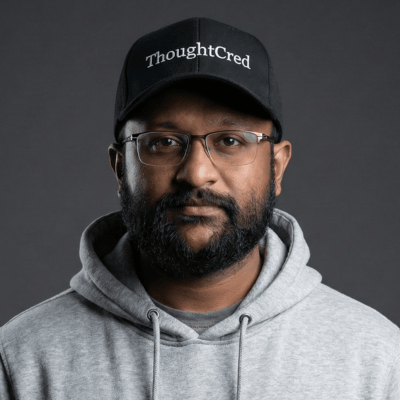
Benjamin Mathew (Ben) is the co-founder of ThoughtCred and an operator who knows how to scale content without sacrificing quality. He grew SaaSindustry.com from zero to 100K monthly visitors with 2,000+ articles, led marketing for Umagine Chennai 2023 (50,000+ attendees), and built a 12-person content team at Thompson Birkman. Ben ensures ThoughtCred’s content engine stays fast, consistent, and strategically sharp.



.svg)


